The May Squeeze: What TRREB’s Latest Stats and Ontario’s Bill 98 Mean for GTA Real Estate
The official May 2026 real estate data from the Toronto Regional Real Estate Board (TRREB) has dropped, and it confirms what many local property hunters have been feeling on the ground: the Greater Toronto Area housing supply is drying up fast.
While much of the media focus over the past year has been on softer year-over-year prices, the underlying mechanics of the market changed gears in May. Sales are up, new listings are down sharply, and a legislative shakeup at Queen’s Park is aiming to alter how homes are built in Ontario.
Let's dissect the numbers from the June 3rd report and look at the bigger policy picture changing the GTA landscape.
The Supply Squeeze: Month-over-Month Tension
Looking strictly at year-over-year figures can sometimes obscure immediate shifts. To see where the market is going, we have to look at the seasonally adjusted month-over-month changes between April and May 2026:
Home Sales: Jumped 10 per cent compared to April.
New Listings: Dropped by 2.1 per cent over the same period.
When sales grow at a double-digit monthly pace while fresh inventory shrinks, market conditions tighten rapidly. Standing inventory is being absorbed, meaning the significant negotiating power buyers enjoyed through the winter and early spring is beginning to erode in select GTA neighbourhoods.
Long-Term Pricing Outlook: The Horizon Shifting to 2027
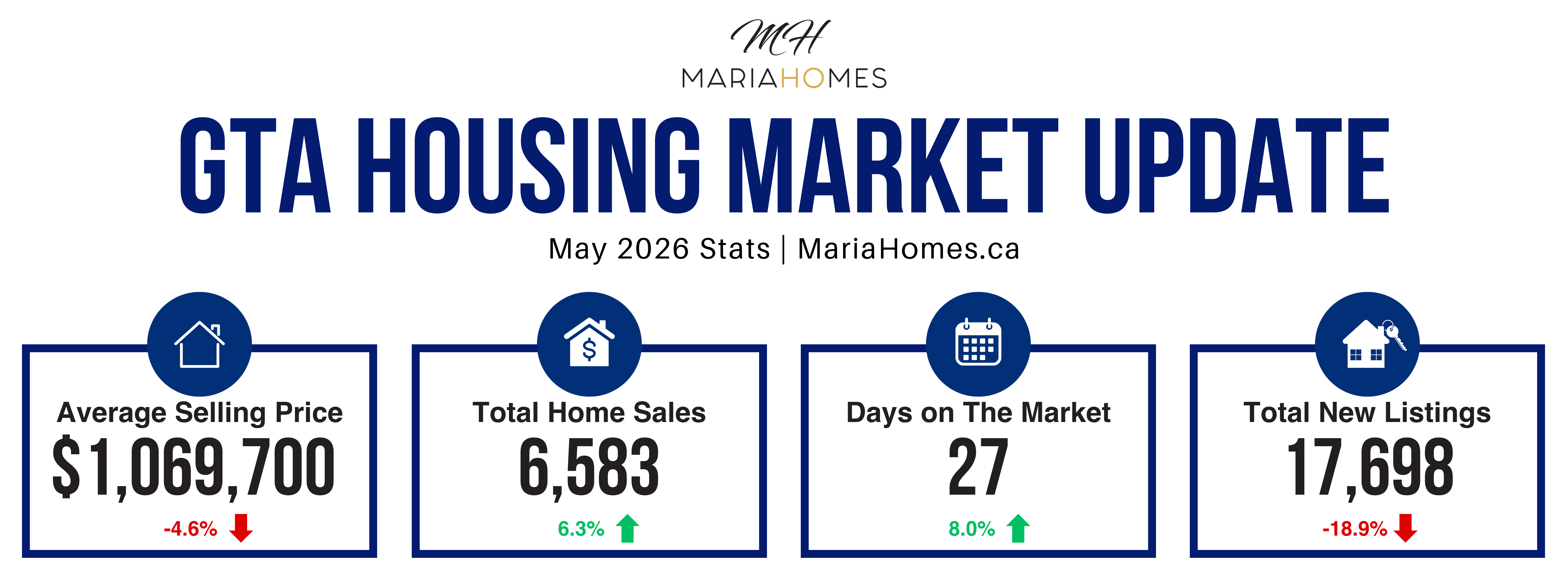
Year-over-year, the average selling price in the GTA sat at $1,069,700 for May, a 4.6 per cent decline compared to May 2025. The MLS® Home Price Index (HPI) Composite benchmark also tracked 6.7 per cent lower over the same timeframe.
However, TRREB Chief Information Officer Jason Mercer pointed out that this window of discounted pricing has an expiration date:
"Inventory levels trended lower over the past year... Looking ahead, if sales strengthen further relative to listings, selling prices will level off and even start to grow as we move into 2027."
For buyers waiting on the sidelines for prices to bottom out completely, the month-over-month price stability suggests that the floor may already be established.
Breaking Down the Red Tape: TRREB, Bill 98, and Housing Supply
The long-term solution to the GTA's affordability issues isn't just about fluctuating borrowing costs—it's about building more inventory. To that end, TRREB’s leadership explicitly threw their support behind Ontario's newly active Bill 98 (the Building Homes and Improving Transportation Infrastructure Act of 2026).
The provincial legislation aims to dramatically cut municipal red tape, accelerate building approvals, and fast-track transit-aligned housing developments.
   TRREB Policy Roadmap ("Removing Roadblocks")
                         ¦
                         ?
             Aligns with Key Measures in
                         ¦
                         ?
    Bill 98: Ontario Infrastructure Act (2026)
                         ¦
                         ?
 +-----------------------------------------------+
 ¦  Faster Approvals     ¦  Reduced Home Costs   ¦
 ¦  Streamlined Rules    ¦  Transit-Linked Nodes ¦
 +-----------------------------------------------+
TRREB CEO John DiMichele emphasized that the province cannot simply rely on demand shifting; it must streamline the path to building the "missing middle" housing—like townhomes and mid-rise multiplexes—that local families desperately need.
The Bottom Line for GTA Residents
We are transitioning out of a stagnant market into a highly competitive, inventory-starved environment. Improved borrowing costs and lower entry prices successfully brought buyers back into the fold this spring.
With provincial initiatives like Bill 98 working to unlock long-term supply, the future real estate landscape will heavily favour those who understand both localized neighbourhood data and macro-level policy shifts.
How are inventory levels looking in your specific part of the GTA? Whether you are looking to buy before prices trend upward or want to time your home sale perfectly, reach out to our team today for a localized market assessment.
We would like to hear from you! If you have any questions, please do not hesitate to contact us. We are always looking forward to hearing from you! We will do our best to reply to you within 24 hours !
We use cookies to provide you the best experience on our website. Click here to view our privacy policy. By continuing to use this site we assume your consent to receive cookies.